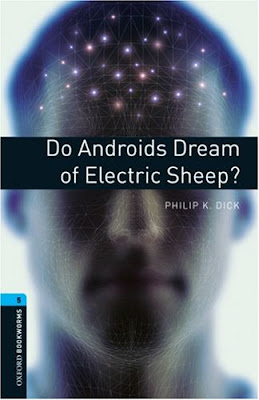
Do Androids Dream of Electric Sheep was first published in 1968 and in the early editions the story takes place in the futuristic year, 1992. Later editions of this book change the year to 2021. The protagonist, Rick Deckerd, is a bounty hunter of androids in a post-apocalyptic future where most of Earth has been evacuated due to the radioactive dust from the last World War. Almost all animals have died, due to the toxic dust, and the people who have chosen to remain on Earth-either for work purposes or because they have been rejected for emigration- suffer from various diseases.
In order to encourage people to move to Mars and other off-world colonies the U.N offeres every new emigrant their own android slave. As the demand for androids increases over the years, new and more sophisticated androids are created until eventually they are so advanced that they can even pass as humans. Some of these more developed androids manage to kill their masters and escape to Earth, where androids are illegal. Rick's job is to hunt down these androids and "retire" them.
The story opens as Rick is woken up in the morning by his mood organ, a machine that allows the user to select the mood they would like to experience, and almost immediately gets into an argument with his wife in which she accuses him of being a murderer. Rick defends himself by stating that he has never killed a human in his life. Despite their physical similarities to humans and their superior intellect, androids are considered the lowest form of life and Rick has no qualms in killing them. But as Rick sets off to hunt down a group of renegade androids that have escaped from Mars he experiences various incidents which cause him to begin doubting his own feelings towards androids and his suitability for his current job.
The title of the book is based on the fact that in this world, a person's social status is affected by their ownership of a real animal. Since all animals are now scarce, and many are already extinct, animals are seen as particularly precious and owning one gives a person status. In addition, since empathy is the key difference between humans and androids, caring for an animal also proves that the pet-owner is empathetic and therefore human. People that can't afford a real animal can buy an electric one instead, which is the unfortunate position that Rick is in. He desperately want's to replace his electric sheep with a real one and hopes that after he captures all of the androids he will finally be able to afford the real thing.
Meanwhile, J.R Isidore, who lives by himself in an abandoned building, discovers that someone new has moved into the apartment below him. Due to brain damage as a result of the toxic dust, Isidore is forced to remain on Earth where he works for electric-animal repair company. Excited by the prospect of having a neighbor, he goes over with the gift of margarine, to make their acquaintance. Isidore soon discovers that his new neighbor is on the run from the authorities, along with three of her friends, and he quickly extends an offer of assistance to them. But these people are different then anyone Isidore knows, they are colder and crueler, and perhaps they aren't even people...
I'm of two of minds about this book. On the one hand, it was a fast-paced, easy to read book that had me fully engrossed from the beginning until the end. It was like watching an action movie. On the other hand, I was disappointed because I was expecting some kind of great climactic event or an interesting and surprising revelation that would tie everything together, but there was neither. The book just ends. I had enjoyed reading the book in expectancy that it was building up to something dramatic, but it really doesn't.
There are also a number of inconsistencies throughout the book as well as many things that go unexplained. Why is there no mention of children in the book, are there none on Earth? What purpose is there for the mood organ and why was it created? J.R Isidore is referred to as a Chickenhead, because of his low-level of intelligence, but what's the meaning behind this term? These questions, and many others, are never addressed, which was another thing that disappointed me.
After finishing Do Androids Dream of Electric Sheep I felt like I must have missed some deep and hidden message in the book, so I turned to Wikipedia for help, but it didn't have much to add. The book apparently questions what it is that makes a person human, rather then an android, which is not a question that has ever really troubled me.
Despite my criticisms, I still enjoyed Do Androids Dream of Electric Sheep as an easy-to-read scifi- book and I think I would like to try more books by Philip K. Dick. I also intend to watch Blade Runner, which is based on this book, to see how it compares. If you are interested in getting into some light science fiction, without any confusing scientific terms and descriptions (which is what always throws me off), this book would be a good place to start.

 Posts
Posts


 I was recently reminder of one of my favorite book characters, who I haven't visited with for quite a while, but who I always think of fondly. And she is Cimorene from Patricia Wrede's Enchanted Forest series. Cimorence is a princess who dares to be different. Rather then learning etiquette and embroidery she takes on fencing, Latin and cooking. And instead of getting captured by a dragon so that a prince could come and save her, she runs away to become a dragon's housekeeper and secretary.
 I was recently reminder of one of my favorite book characters, who I haven't visited with for quite a while, but who I always think of fondly. And she is Cimorene from Patricia Wrede's Enchanted Forest series. Cimorence is a princess who dares to be different. Rather then learning etiquette and embroidery she takes on fencing, Latin and cooking. And instead of getting captured by a dragon so that a prince could come and save her, she runs away to become a dragon's housekeeper and secretary.