Saturday, January 30, 2010

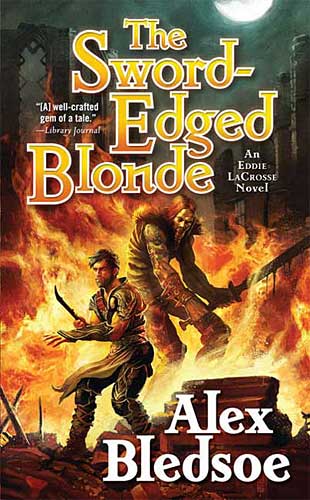
The Sword-Edged Blonde by Alex Bledsoe

Posted by Simcha 5:42 PM, under | 10 comments

Although The Sword-Edged Blonde was published in 2007, I never heard of this book, or it’s author, Alex Bledsoe, until recently- when I seem to be running into reviews of this book everywhere. And since every review I read was full of praise for this fantasy detective novel, I soon ordered myself a copy so that I could find out for myself what all the fuss is about.

Private Eye Eddie LaCrosse is on a case to find a missing princess, but along the way he is intercepted with a message from an old friend who urgently needs his assistance. And so Eddie changes course and heads to Arentia, the city that he once called home, and which he had fled from twenty years ago.

Once in Arentia, Eddie is quickly ushered to the palace where his childhood friend, King Phil, is devastated over the recent murder of his baby, and the fact that his beloved queen is the main suspect. But King Phil doesn't believe that his wife really committed this crime, despite the seemingly indisputable evidence, and so he hires Eddie to discover the truth about what happened the night of the murder.

Eddie immediately takes on the case, but first insists on meeting with the queen herself. Upon confronting Queen Rhiannon, Eddie is shocked to be faced with a woman who he had once known, and whom he had seen die. Eddie soon finds himself setting out to uncover the truth about Queen Rhiannon, and in the process is forced to confront his own painful past and those events that led him to flee his home and abandon his friends.

The Sword-Edged Blonde is an interesting mix of genres; a detective novel with elements of fantasy which takes place in an medieval type setting. The character's names and speech are modern, but the technology is old fashioned and Eddie fights with a sword rather then a gun.

This was definitely a fun book to read, with plenty of action and adventure and lots of wonderful characters. I did find myself a bit thrown off by the modern names and language, which distracted me a little from the story, and some of the aspects of the mystery solving seemed pretty weak. I was also not particularly satisfied with the resolution to the mystery, which I felt was rather far-fetched and relied too much on the fantasy aspect of the book, which until then had been underplayed. The solution also revealed the participation of a character in a manner which I found wholly unbelievable, and which still bothers me when I think about it, days after finishing the book.

But these flaws didn't bother me enough to detract from my enjoyment of the story, particularly since I'm not much of a mystery reader anyways. I thoroughly enjoyed losing myself in the world of Eddie LaCrosse and I look forward to picking up the next book in the series, Burn Me Deadly.

Thursday, January 28, 2010

Children's Book Review: Carl's Snowy Afternoon

Posted by Simcha 6:47 AM, under | 3 comments

I've never written a review of a children's book before but since these are pretty much the only books I'm getting to read lately (due to my very demanding two year old), I figured I might as well start writing about some of them.


Whenever my in-law visit us from America, they bring with them suitcases full of children's books, helping us restock our bookshelves (well-loved books don't last long around here). On their recent visit their suitcases included a copy of
Carl's Snowy Afternoon, Alexandra Day's most recent Carl the dog book.

In
Carl's Snowy Afternoon, Carl and the little girl (whose name is Madeleine, though this is never mentioned in the book) are left at home with the babysitter while the mother and father go to a party by the frozen pond. As soon as the parents leave and the babysitter is ensconced in front of the TV, Carl assists Madeleine in donning her boots, coat, scarf and gloves, and they sneak out the door for some fun in the snow.

First Carl and Madeleine join a group of children building snowmen (and snow-dogs) and then they go sledding, after which they try skating on the frozen pond. But Carl soon spots Madeleine's parent, and so they switch directions and head over to the hot dog stand where they each manage to snatch for themselves a snack. After assisting a rabbit in claiming the carrot nose of the snowman, Madeline and Carl head back home where they divest Madeleine of her wrappings just as her mother gets home, promising to take Madeleine outside tomorrow to play in the snow.

As usual, Day manages to vividly tell an amusing and engaging story through her enchanting drawings. While
the escapades in Snowy Day were not quite as humorous as those in previous books in the series, the pictures really bring to life the wonder and delight of a snowy evening through the eyes of a child. I particularly love the picture of Madeline and Carl standing with their mouths open, catching snowflakes. There was also a bit more dialogue in this book then in the others I read, due to the fact that Madeline is now older and can converse with Carl.

My two-year old loves this book and brings it to me over and over again to be read, which I don't mind since there aren't too many words so we just discuss the pictures. My older children (aged 5,6 and 8) were briefly interested in the book since they have never seen snow before, but in general they seem to prefer Day's more humorous Carl books.

Favorite Fictional Character: Artie

Posted by Simcha 5:55 AM, under | 3 comments

Favorite Fictional Character
Hosted by Ryan at Wordsmithonia

When I was younger, one of my favorite authors was Gordon Korman, with his funny and creative books populated by memorable characters. His books were the only ones that really made me laugh out loud while reading them, and sometimes just thinking about them would make me crack up (and got me strange looks from my friends). Occasionally I still get out his books and read them because they are just so much fun.

One of my favorite of Korman's characters is Artie, from No Coins Please. Artie is an intrepid eleven year old boy whose favorite hobby is making money. Concenened about her unconventional son, Artie's mother signs him up for a tour group for kids. But Artie just sees the road trip as another opportunity to make money, and along the way he manages to rope in the rest of the kids in his group in his money making schemes.

In New York Artie makes a killing selling "attack jelly," and in Colorado he makes a fortune by turning an abandoned pretzel factory into a disco. In Washington he sets up a gambling ring using a toy racetrack and while on a stopover in the country, Artie rents cows from the local farmer and then charges tourists to milk them. Meanwhile, the counselors are baffled as to how Artie keeps managing to escape their watch, though when the FBI goes after Artie they know they are in real trouble.


When reading this book, I had always wished I had a friend as interesting as Artie, though now I'm also thinking that I feel bad for his poor mother and that I'm glad he's not my kid.

Wednesday, January 27, 2010

Scifi for beginners: Dune by Frank Herbert

Posted by Simcha 4:42 PM, under | 7 comments


When Duke Leto is ordered by the emperor to transfer to the planet of Arrakis, both he and Lady Jessica are aware that the Harkonnens won’t easily relinquish their hold on the desert planet, which until recently was in their control. For, whoever rules Arrakis controls the production of the valuable spice that is harvested there. And so Leo and Jessica arrive at their new home on-guard and prepared for an attack.

But when the attack does come, it is geared at their son Paul, and it appears to have been set up by someone within the household. Both Leto and Jessica recognize that there is a traitor amongst them, and various clues point to Jessica as the culprit, a possibility that many of Leto’s supporters are quick to accept due to her background as a Bene Gesserit “witch”.

Meanwhile, Paul, who has the talent for sensing the truth in other’s words and for dreaming about future events, finds himself strangely familiar with Arrakis and it’s ways. And the people of Arrakis begin to suspect that Paul and his mother may be the figures from prophecy that they have been awaiting to lead them into a future of freedom and hope.


Duke Leto and Lady Jessica must navigate within the web of deceit and treachery, as they try to discover who their real enemies are and how to overcome them and Paul finds himself setting off on a path which will forever change him, bringing him closer to the future that he had once dreamed about.


I had started reading Dune with very low expectation of enjoying it, largely due to the fact that I’m not much of a scifi reader and neither the plot summery or the rather dull book cover interested me much. And so I was pleasantly surprised when I was immediately drawn into the story by the interesting characters and engaging narrative style.

The world of Dune is inventive and convincing; particularly in it’s emphasis on the conservation of water. On Dune, water is so precious and scarce that life revolves around it, particularly for the Fremen, who dwell in the harshest areas of the desert. The Fremen even invented garments that recycle all of the body’s liquid, so that not a single drop of sweat would go to waste. I was so consumed by the ideas presented in Dune that I couldn’t help but reconsider the elaborate use of water all around me in my every day life.

And the monstrous man-eating worms, which at first I had thought sounded rather cheesy, were actually a very creative touch.


The characters are well developed and memorable, particularly Paul, who transforms from a playful child to a hardened adult, trying to avoid the dangerous future that he sees himself heading towards. Though I was saddened by the changes this wrought in his relationship with his mother, and the new distance that developed between the two of them as Paul left his childhood behind.

And while Dune is a science fiction book, I didn’t feel myself overwhelmed by complicated futuristic inventions and scientific terminology, which usually throws me off in books of this genre. The characters here have actually reverted back to the use of swords as weapons, due to the danger of using firearms against shields. I have to admit though, that I didn’t get what the shields were. I don’t remember there being any mention of what they are made of or how they work exactly so I just couldn’t picture them in my mind, which irritated me a bit. There were actually a few other things like this, ideas or statement that I never quite understood, but they were infrequent enough that they didn’t get in the way of my enjoyment of the book.

I think Dune is an excellent book that anyone can enjoy. While the science fiction elements are present, they don’t overwhelm the story, making it a book that can be enjoyed by readers of any genre.

----------------------------------------------------------------------------------------------------
Looking for Answers:

As I mentioned above, there were a few matters that I still remained unclear about after finishing the book and I thought some of you who have already read it might have some answers for me.

First of all, a few times references were made to "being human," such as, in the beginning of the book, when the Reverend Mother tells Paul that she is testing him to see if he is human. Well, what were the alternatives?

Second, I thought it was strange that Hawat was so easily tricked when he was supposed to be of such superior intelligence, as one of the top mentats. Anyone else think that is was odd?

Third, I was unclear about how the rest of the residents on
Arrakis received water and water their situation was. And if water was so scarce for the Fremens that they had to recycle it all, how could they be drinking coffee?

So if you have any answers for me, I'd love to hear them!

Sunday, January 24, 2010

My plans for the new week

Posted by Simcha 4:45 PM, under | 10 comments

Here in Israel we start off the new week by wishing everyone "shevuah tov!" Which means "good week," and I think it's a great greeting to start off the week with. So shevuah tov everyone and I hope you have been enjoying some good reads lately.

While I usually manage to get at least one or two books read a week, for the past week and a half I've been wholly occupied with a single book,
Dune. I must admit that I am definitely enjoying Dune much more then I had expected to, but it's also requiring a lot more of my concentration and time then many of the other books I normally read. I hope to finish Dune by tomorrow, after which I will continue on to a few other books that I have been looking forward to reading.

I recently ordered two books that I have been hearing a lot about and have piqued my interest; The Sword-Edged Blonde, by Alex Bledsoe and The Name of the Wind by Patrick Rothfuss. I also got a hold of a book that I had read fifteen years ago and I remember really liking, called Villains by Necessity by Eve Forward. Strangely enough, Eve Forward only published one other book after this one, and that one was supposed to be the start of a trilogy. When I tried looking Forward up on the Internet I couldn't find any information about her and so now I'm particularly curious to see if Villains by Necessity is really as good as I remember it being.

I also need to start making some progress with the few challenges that I have joined. There are really so many interesting reading challenges going around now, but I have limited myself to only joining two of them, since I really hate committing myself and I know that I'll be hard pressed to even complete these two.


One of these challenges I had previously mentioned, and that is the Read a Book See the Movie Challenge, in which you review a book along with the movie that is based on it. And while I'm not having any trouble with the book reading part, finding the time to watch the movies is the real challenge for me. I plan to watch and review Dune as well as Blade Runner, for which I read Do Android Dream of Electric Sheep.


The second challenge I joined is hosted by Storytime with Tonya and Friends and is a Short Story Challenge in which you can choose different levels of participation. Tonya even offers a wimpy level, which allows you to participate in any manner you wish. I like this challenge because I'm not much of a short story reader though I've heard that there are some really good science fiction short stories, and since I already own quite a few scifi compilations, I thought this challenge would give me the incentive to start reading some of them. Books on the Nightstand also once had a podcast in which they recommended some short story collections that sounded really interesting, so this would also be a good opportunity for me to try some of those.


There is also one other challenge that I have been participating in recently, and that is The Comment Challenge at MotherReader in which you are supposed to comment at, at least, five different book blogs a day. This challenge is a great way to get into the habit of leaving comments for other bloggers and to discovers interesting new blogs. I have already gotten some new visitors through this challenge and I've also found some interesting new blogs to follow.

So I have some pretty ambitious plans for the upcoming week, and I really hope to accomplish at least a few of them. But first- must go finish Dune....


Thursday, January 21, 2010

Interview with Gail Carriger

Posted by Simcha 4:35 PM, under | 4 comments

Gail Carriger is the author of the wonderfully entertaining new novel, Soulless, in which she provides a fresh new take on the paranormal scene; placing vampires and werewolves in Victorian London, where they influence fashion, society and government. Carriger also introduces an interesting new concept of the lack of soul and it's ability to neutralize the supernatural, in the form of the feisty, delightful heroine, Alexia.

Immediately after finishing Soulless, I contacted Gail with a request for an interview so that I could ask her about some of these interesting ideas that she introduces in her novel, as well as to find out more about this intriguing new author.


Hi Gail. Thank you so much for taking the time from your busy schedule to do this interview with me.

My pleasure. I'm sorry I was so delayed in getting back to you! The life of an author: complete boredom broken by spates of utter panic.
(For the record, Gaile was surprisingly prompt at returning my emails and answering my questions)


After finishing Soulless, I went over to visit your website where I discovered that in addition to writing you are also
an archeologist, a field that I have always been fascinated with. Can you tell me a bit about your archeological work? How has your background in archeology influenced your writing?

I have an MS in materials archaeology with a focus on inorganics, and an MA in anthropology with a focus on ceramic artifact analysis. Which means that while I have some field experience I've spent most of my time in the laboratory sticking artifacts into very expensive instruments that go "beep."

I've worked on artifacts from Egypt, Italy, Greece, Britain, Rome, North America, and the Islamic Empire. Now I'm associated with an excavation in Peru, and I do go into the
field once a year, but I'm still in a lab while I'm there.

A career as an archaeologist and academic has given me good research skills, a serious respect for deadlines, a fascination of historical cultures, and, most importantly, the ability to subsist entirely on instant soup. It has also made me obsessed with objects. Readers may notice that what people wear and own is almost as important as what they do and say in my books.


I noticed from your website that you have a very strong interest in steampunk fiction and fashion. How did you first get interested in this genre and what is it about steampunk that particularly excites you?

Steampunk is the future as the Victorians imagined it, where steam power never died, and electricity never dominated. Think Jules Verne and hot air balloons flying to the moon. The gothic literature movement saw the birth of science fiction, during the Victorian era. The current steampunk movement is a weird kind of full circle ~ I love that. I honestly can't remember how I first got into it. It just happened.

Um...I'll now have to sheepishly admit that I have never actually read anything by Jules Verne.
Since I am completely unfamiliar with steampunk, can you please clarify for me which aspects of Soulless are considered steampunk and what exactly is steampunk fashion?


Technically speaking, Soulless should have a lot more science to be fully steampunk, it dabbled a bit too much with Other Sub-Genres ~ the slut! But the idea is there, and I didn't want to overload new-to-steampunk-readers with too much gadgetry all at once. Alexia's world is steampunk: an alternate 1800s England with new and different mechanicals, evil scientists, and attack automatons. As the series progresses, the science creeps more and more to the fore, although I do try and keep it from getting all techno-babble.

I suppose Soulless might be considered steampunk-light ~ would that be fluffy-cloud-punk?
The current aesthetic movement (essentially the visual equivalent of the love child of a BBC costume drama and Hot Topic) emphasizes the importance of creativity, found object art, and the maker mentality ~ all of which I find very exciting. If you're still curious, I did a recent blog post on the subject http://gailcarriger.livejournal.com/121010.html


In
Soulless, there is a lot of focus on Alexia’s soulless status, but it’s mainly in relation to the effect it has on supernatural creatures. Alexia does mention, in the beginning of Soulless, that she felt she had to come up with her own moral standards because she had no soul of her own, but this idea wasn’t expounded on, and Alexia does seem rather unaffected by her lack of soul. Are there any other implications of not having a soul in Soulless, aside from its scientific effects?

The biggest side effect of being soulless is pragmatism. This makes Alexia both typical and wildly atypical for a female of the Victorian era. The atypical aspects come from the fact that, being soulless, she simply sees the world differently. She also has absolutely no creative skill and very little imagination. However, because of her pragmatism she recognizes these flaws in herself and tends to surround herself with friends, intentionally or subconsciously, who compensate for her own inabilities. Alexia is not one of those heroines who charges forth, one woman against the machine. She seeks out advice, travels in company, and gets things done by committee, that's also a side effect of her lack of soul. As the series continues, hopefully, this will become clearer.


You have so much wonderfully humorous dialogue in Soulless, I was wondering, how do you go about successfully putting humor into words? Do you find writing humor to be more challenging then other kinds of writing?

Very challenging indeed. I have a post-it note on my computer that says, "Gail, don't lose the funny!" Unfortunately for me, editors kept buying comedy from me and nothing else, so now I'm stuck with it. The "how" is a difficult question to answer. There are intrinsically funny words, situations, and characters so throwing any one of those into a scene always works. I watch and read a lot of comedy, and I'm always alert to funny things around me. I've developed an inconvenient tendency of stepping back while reading, watching, or talking and thinking, "Now, why was that funny?" I don't necessarily copy the occurrence, but I do file it away as a technique. I have a personal addition to bad puns and ludicrous analogies, so sometimes I can go overboard. My editor is good about reining me in.


You mentioned in an interview that you were uncomfortable with writing the more “adult” scenes in your book. Do you think it’s possible to write romance these days without including descriptive love-making scenes? How do you decide on how many such scenes to include? ( I notice that most romance novels have at least three)

I include them where I feel they happen naturally. However, I don't feel that a romance has to have descriptive love-making. My nookie scenes tend to be rather gentile. That is, you may notice I never refer to any indelicate bits by name. I like the traditional literary idea of romance, focusing on the relationship. Which is not to say I don't enjoy the occasional erotica, just that I like to know that's what I'm getting into.

While Soulless was very much a romance, I heard that the sequel, Changeless, will be less so. Can you tell me a bit about what we expect from the Alexia and Lord Conall in your upcoming book?

I borrow a lot from traditional Gothic literature tropes. So while Soulless was loosely based on a Gothic romance model, Changeless is more of a Gothic mystery (think early Sherlock Homes) and Blameless uses a lot of Gothic adventure, Quartermain-style. So while Alexia and the irrepressible Lord Maccon are still there, the romance is a little less important to the plot of the next book.


What one steampunk book would you recommend to readers who are unfamiliar with the genre but would like to give it a try?

I'm going to branch out and pick a graphic novel, I hope that's OK. There's none better than the original League of Extraordinary Gentlemen.

With all of the traveling that you do, is there any one book that you always make sure to bring with you, no matter where you go?


Nope, but I always carry a notepad and pen or a digital Dictaphone. Always. I learned that lesson the hard way.
--------------------------------------------------------------------------------------------------------------
Thanks again Gail for taking them time to answer these questions for me, and I can't wait to read the next book in the series, Changeless, which will be released on March 30th.

To learn more about Gail Carriger, you can visit her website or blog
You can also take a look at some of her other interviews:

Interview at the Book Whisperer

Interview at BSC Review

Interview at Sc-Fi Fan Letter

Wednesday, January 20, 2010

Favorite Fictional Character: The Fonz

Posted by Simcha 4:16 PM, under | 5 comments

Favorite Fictional Character
Hosted by Ryan at Wordsmithonia

Inspired by Ryan's nostalgic memories of his favorite childhood cartoons, I decided to focus on another one of my favorite TV characters, Arthur Herbert Fonzarelli, or "The Fonz."

I don't remember when I first discovered Happy Days, but once I did it became one of my favorite TV shows, which is largely due to the star of the show Fonzie, a high school drop-out and former gang member, who eventually mends his ways, after befriending Richie Cunningham and his family.

The Fonze was the ultimate in cool; commanding the bathroom of the local hangout as his office and getting any song on the jukebox playing, just by hitting it with his fist. Interestingly enough, Fonzie was only supposed to appear in a few episodes of Happy Days, but his character was so popular that he was made a regular on the show and eventually received top billing.

I actually almost got to meet Henry Winkler once, when I was a teenager, and he was speaking at a Jewish fund raising event that my mother was attending. But I got sick the night before, and my sister went instead. She even got a kiss from Winkler, and all I got was an autographed napkin ( with my name misspelled). Sigh. Sometimes life just isn't fair.


Tags

Book Reviews

Blog Archive

Blog Archive